
Updated Medical Causation Assessment in Injuries

When the Medical Opinion Changes: Why Updated Causation Assessments Matter
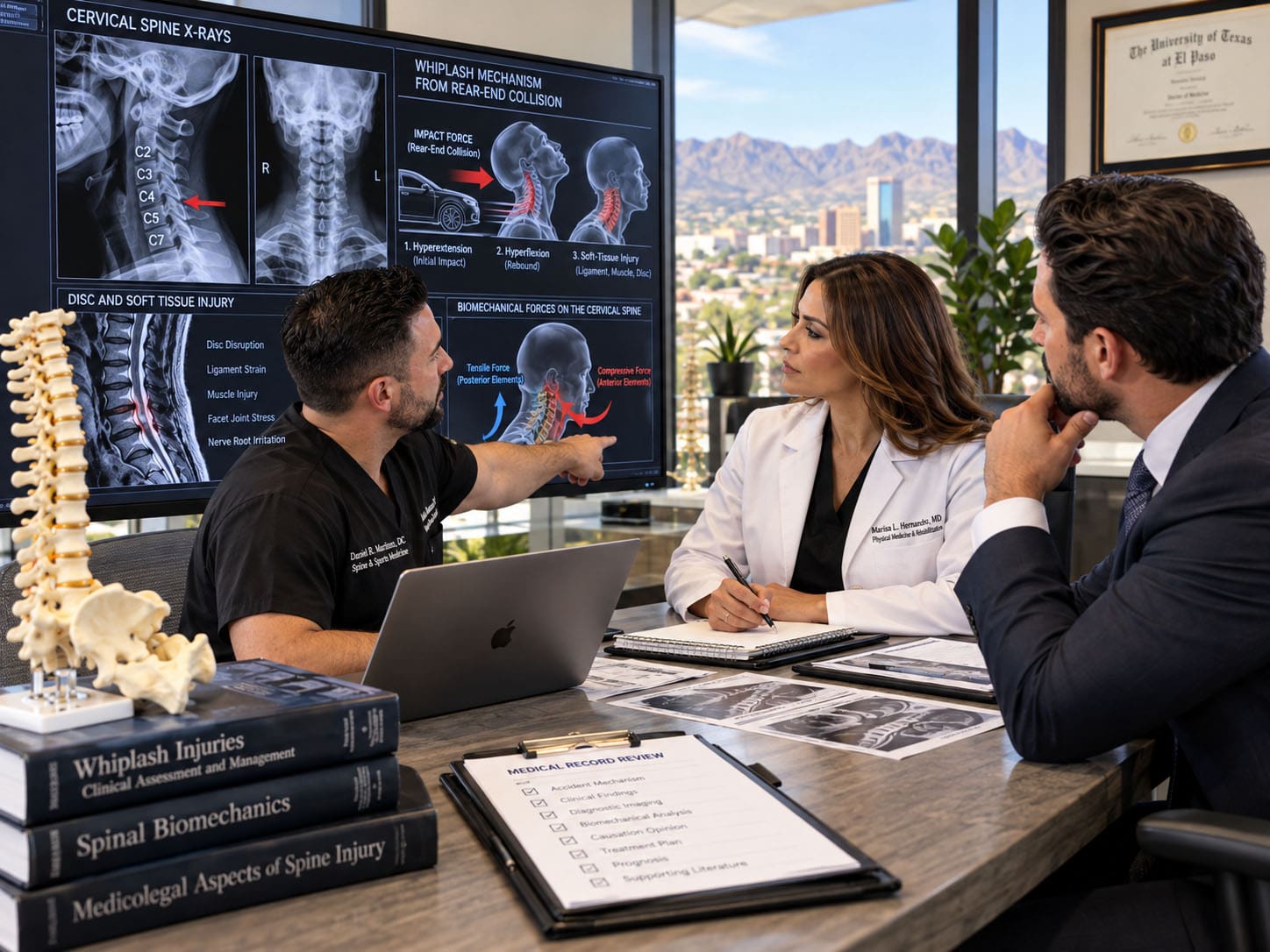
A rear-end collision on the I-10 corridor near El Paso leaves a patient with neck and mid-back stiffness that seems straightforward at first. Early records note muscle guarding and limited range of motion. Weeks later, the same patient reports new radiating arm pain, grip weakness, and sleep disruption that does not match the original soft-tissue picture. A follow-up MRI, ordered after careful clinical progression, now shows a disc herniation with annular disruption and mild cord contact that was not described on the first study. The clinical opinion must change.
This is not a failure of the initial assessment. It is the normal, responsible evolution of medical understanding when new objective data, specialist findings, or clear symptom progression appear. In personal-injury cases, an updated causation assessment can strengthen both the patient’s recovery path and the legal record. At Injury Medical Clinic PA in El Paso, the multidisciplinary team led by Dr. Alex Jimenez, DC, APRN, FNP-BC, CFMP, IFMCP, and Medical Director Dr. Maria Guadalupe Cardenas, MD, treats opinion updates as a core part of accurate, ethical care.
Why Medical Opinions Appropriately Change
Causation analysis is not a single snapshot. It is a living evaluation that compares the patient’s pre-event baseline with everything that follows the trauma. New information commonly and correctly revises the picture:
- New or interval imaging. Comparative studies can show interval change—new disc protrusion, bone-marrow edema, ligamentous signal, or progression of stenosis at a specific level. What looked like age-related findings on an early film may later prove to be acute or traumatically aggravated once the timeline and clinical correlation are clear.
- Specialist evaluations. A neurologist’s electrodiagnostic testing, an orthopedic review of mechanism, or an internal-medicine assessment of metabolic contributors can refine or expand the diagnosis. These inputs do not contradict the treating team; they complete it.
- Symptom progression or delayed emergence. Soft-tissue injuries sometimes unmask underlying structural problems. Radicular symptoms, myelopathic signs, or functional decline that appear after the initial acute phase must be explained rather than dismissed. Biological plausibility and temporal relationship still govern the analysis.
- Alternative or concurrent diagnoses. Inflammatory markers, metabolic panels, or exclusion of non-traumatic causes can isolate the traumatic contribution. Under the Texas eggshell-plaintiff principle, pre-existing degenerative changes do not bar recovery when the trauma demonstrably aggravated them or produced new clinical findings.
Medical experts have a recognized duty to re-examine their opinions when the evidence changes. Courts and practice guidelines emphasize that an expert who revises a view because of new imaging, new history, or a new clinical course must communicate that revision promptly and transparently. Doing so protects the integrity of both the medical record and the legal process.
How the Clinic Builds and Updates Causation
The Injury Medical Clinic PA process begins with mechanism-of-injury analysis and objective baseline data, then continues through serial evaluation. Digital imaging, functional testing, and detailed electronic notes create a contemporaneous chronology that is useful for both clinical decisions and Colossus-style claim review.
Dr. Jimenez’s dual licensure as a Doctor of Chiropractic and board-certified Family Nurse Practitioner allows him to integrate structural findings (spinal alignment, soft-tissue integrity, biomechanical stress) with medical diagnostics and advanced treatment modalities. He collaborates with Dr. Cardenas, whose internal-medicine expertise guides advanced laboratory panels, risk stratification, and management of complex metabolic comorbidities that can influence healing. Together they produce documentation that distinguishes:
- New traumatic injury,
- Aggravation of a previously asymptomatic or stable condition, and
- Temporary exacerbation that returns toward baseline.
When an opinion is updated, the record typically includes the date of the new data, the specific findings that prompted the change, the clinical correlation, and the revised causation statement. Notes remain objective, time-stamped, and free of advocacy language, helping them withstand insurance-defense scrutiny and support Letters of Protection.
Patient Gains from an Accurate, Updated Opinion
An updated assessment is not merely a legal document; it is a clinical tool. When the team correctly identifies an emerging disc injury or radiculopathy, care can shift to targeted interventions that address the underlying tissue and nervous-system problem. Patients commonly experience:
- Improved pain control and reduced reliance on heavy medication through non-invasive options such as chiropractic adjustments that restore motion segments and electroacupuncture that modulates neural signaling,
- Better sleep as inflammatory and mechanical drivers are addressed,
- Faster return of mobility and daily function once the correct structural and metabolic factors are treated, and
- A clearer understanding of their condition, which supports informed decisions about further care.
These gains align with core bioethical principles. Beneficence is served by treating the root drivers revealed by new data rather than continuing a plan based on outdated findings. Non-maleficence is advanced by preferring low-risk, drug-sparing approaches (adjustments, electroacupuncture, photobiomodulation, targeted IV or peptide protocols when indicated) that reduce the risk of unnecessary surgery or prolonged opioid exposure. Autonomy is respected through plain-language education so the patient remains the decision-maker and can coordinate seamlessly with any existing physicians.
Value for El Paso Attorneys and the Legal Record
Attorneys need a medical partner who will revise an opinion when the science requires it and who will document the revision carefully. An updated causation assessment that references comparative imaging, specialist input, and the clinical timeline provides stronger support for proximate causation—the link between the crash forces (rapid deceleration, blunt impact, whiplash kinematics) and the documented injuries. It also helps isolate traumatic aggravation from purely degenerative change, consistent with Texas eggshell-plaintiff principles that hold a defendant responsible for the full harm caused, including the worsening of a pre-existing vulnerability.
Because the clinic’s notes are detailed, contemporaneous, and Colossus-compatible, they supply the objective foundation many carriers and defense experts demand. When future-care recommendations are later refined, the same transparent process lets you update the cost projection without appearing inconsistent.
Practical Steps When New Information Arrives
Patients and their counsel benefit from a clear sequence:
- Prompt reporting of new or worsening symptoms so imaging or specialist referral can be timed appropriately.
- Comparison of pre- and post-event studies whenever available.
- Serial functional measures (range of motion, strength, neurological findings) that track progression or response to care.
- A concise addendum or updated narrative that states what changed, why the opinion shifted, and how the new findings relate to the original trauma.
This approach keeps the medical record coherent and defensible while keeping treatment focused on the patient’s actual recovery needs.
Updated causation assessments reflect rigorous, patient-centered practice rather than a weakness. When new imaging, specialist insight, or clear clinical progression arrives, the responsible response is to re-evaluate, document the basis for any change, and adjust care accordingly. At Injury Medical Clinic PA, Dr. Jimenez and Dr. Cardenas build that process into their daily collaboration. The result is clearer medical truth for the patient, stronger objective support for the legal claim, and a treatment plan that continues to target root causes with non-invasive, function-restoring methods.
Patients recovering from crashes, falls, or workplace trauma—and the attorneys who represent them—can rely on this disciplined approach to keep both healing and the medical-legal record aligned with the evolving evidence.
From Injury to Recovery with Chiropractic Care | El Paso, Tx
References
American Medical Association. (2024). AMA Guides to the evaluation of permanent impairment (6th ed.). https://ama-guides.ama-assn.org
Hill, A. B. (1965). The environment and disease: Association or causation? Proceedings of the Royal Society of Medicine, 58(5), 295–300. https://doi.org/10.1177/003591576505800503
Santos, E. M., Watson, R. A., Dixon, A. E., & Whang, P. G. (2025). A comprehensive review of injury causation analysis methodology for the assessment of workers’ compensation and motor vehicle collision injuries. Journal of the American Academy of Orthopaedic Surgeons, 33(5), 212–220. https://doi.org/10.5435/JAAOS-D-24-00112
Duty of care for experts: Experts must constantly reconsider their opinion in the light of changing evidence. (2025). The Bulletin of the Royal College of Surgeons of England. Advance online publication. https://doi.org/10.1308/rcsbull.2025.75
Texas Civil Pattern Jury Charges. (Current edition). PJC 28.8B (aggravation of preexisting condition). State Bar of Texas.
Scarcliffe v. Brampton Valley Group Ltd [2023] EWHC 1565 (KB).
Koch v. United States, 857 F.3d 267 (5th Cir. 2017).
NexLaw. (2026). How to build a medical chronology for a PI case. https://www.nexlaw.ai/blog/how-to-build-medical-chronology-personal-injury-case/
Greater Texas Orthopedic Associates. (2026). How orthopedic causation is established in PI cases. https://greatertxortho.com/orthopedic-causation-personal-injury/

Comments are closed.