

Attorney Chiropractor Partnership in Personal Injury Cases

The Attorney-Chiropractor Partnership: Where Collaboration Helps and Where Clinical Independence Must Remain
Personal injury cases often place attorneys and clinicians around the same patient but give them very different responsibilities. The attorney protects legal rights, develops the claim, preserves evidence, and explains litigation strategy. The clinician evaluates injuries, rules out dangerous conditions, establishes diagnoses, recommends treatment, measures recovery, and records medical opinions. Those roles can complement each other powerfully after a motor vehicle crash, slip-and-fall, or workplace accident. They should never merge.
For El Paso attorneys, the most useful medical partner is not a clinician who promises a favorable opinion. It is a clinician who produces clear, timely, internally consistent records and is willing to explain how the evidence supports—or does not support—a medical conclusion. For patients, that independence matters even more. Their health should remain the center of every decision.

What Attorneys Need From Treating Clinicians
A personal injury attorney usually needs a medical record that answers practical questions without turning the chart into a legal brief. When did symptoms begin? What mechanism of trauma was reported? What did the examination show? Are there objective findings? What diagnoses reasonably fit those findings? How has the patient’s function changed? What treatment was recommended, and why was it medically necessary?
In Texas, expert opinions are more useful when the underlying facts and data support them. Texas Rule of Evidence 702 allows qualified experts to provide specialized opinions that help the factfinder, while Rule 705 permits examination of the facts and data underlying those opinions (Supreme Court of Texas, 2026).
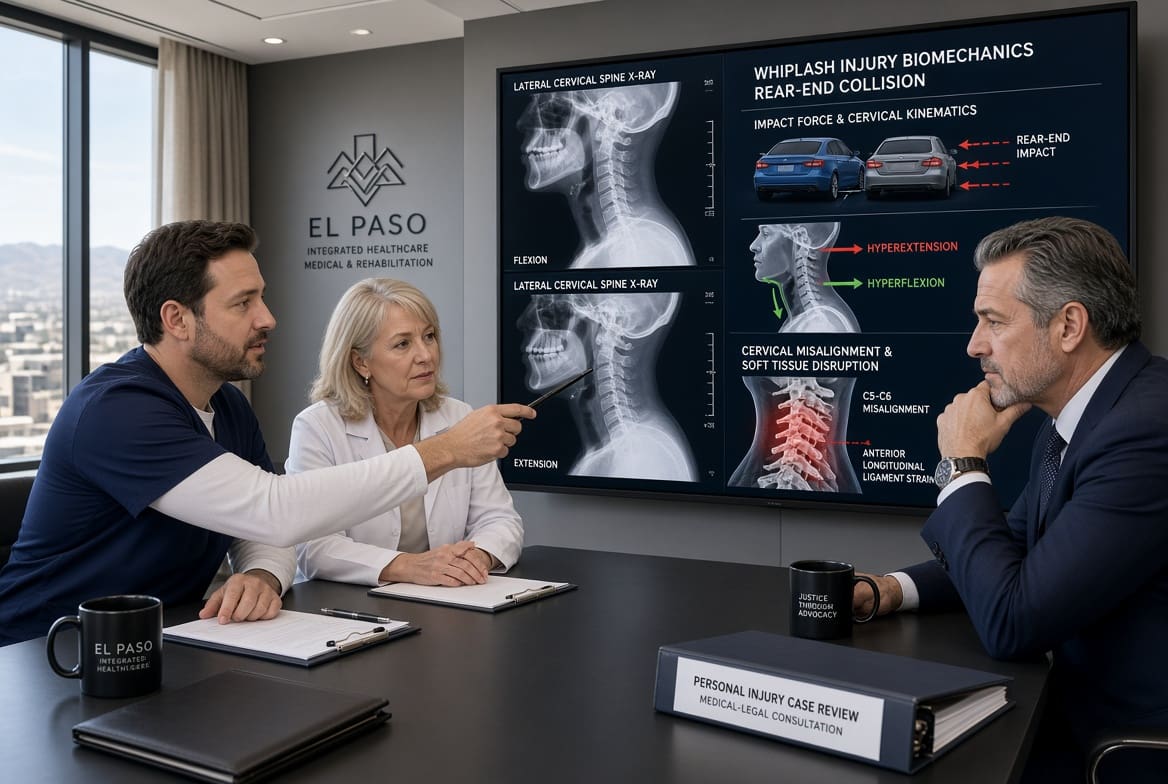
That means an attorney benefits from documentation that connects the pieces rather than merely listing them. A strong injury note may link rapid cervical flexion-extension in a rear-end collision to new neck pain, reduced range of motion, muscle guarding, neurologic findings, and clinically relevant imaging. When appropriate, it should also address competing explanations, including prior injuries, degenerative changes, chronic symptoms, or a later event.
What Clinicians Need From Attorneys
Clinicians also need useful information from counsel, but the information should support accuracy rather than influence medical judgment. Attorneys can help by obtaining collision reports, photographs, emergency records, prior imaging, employment information, witness information, and other materials that clarify the timeline. These records may help a clinician understand the forces involved, identify inconsistencies, or consider other explanations.
Clinicians do not need a preferred diagnosis, a preferred impairment level, a desired treatment duration, or pressure to describe causation more strongly than the medical evidence allows. The clinician’s chart should reflect the clinician’s reasoning.
The Texas Disciplinary Rules prohibit lawyers from falsifying evidence, assisting a witness to testify falsely, or offering compensation contingent on the substance of testimony or the outcome of a case (State Bar of Texas, 2025). The AMA likewise states that physicians providing testimony should be honest, objective, appropriately qualified, and free from outcome-contingent influence (American Medical Association, n.d.).
Clinical Independence Is the Bright Line
An attorney may ask a clinician to explain a diagnosis. Counsel may request a narrative report, clarification of terminology, or an opinion about whether a mechanism is medically capable of producing a documented injury. Counsel may also identify missing records or ask whether the clinician considered a preexisting condition.
The attorney should not rewrite the medical conclusion.
Clinical independence means the provider remains free to say that the evidence supports causation, supports aggravation of a preexisting condition, remains uncertain, or does not support the alleged connection. That independence also helps defense reviewers, judges, juries, and insurers separate genuine clinical reasoning from advocacy, which can later strengthen the credibility of both records and testimony.
Attorneys determine legal strategy and argue legal causation. Clinicians determine diagnosis, medical necessity, prognosis, treatment recommendations, and medical causation within their training and scope. Keeping those questions separate reduces the risk that the chart begins to look advocacy-driven.
Medical Record Integrity Must Be Protected
The medical record is created first for patient care. It may later become important evidence, but litigation does not change the obligation to document accurately.
Record integrity starts with contemporaneous notes. Record history, examination findings, diagnoses, treatment, response to care, referrals, restrictions, and follow-up plans close to the encounter. Repetitive copy-and-paste language, unexplained diagnosis changes, identical measurements across multiple visits, or unsupported statements can undermine credibility.
If you discover an error, the safer approach is usually a transparent correction or addendum rather than silently rewriting a signed note. Federal HIPAA rules give patients a process to request amendments, and accepted amendments must link to or append to the affected record rather than simply erase the historical record (HHS, 2025).
An attorney may appropriately alert a clinic to a factual inconsistency: the wrong accident date, an incorrect body part, a medication entered in error, or a missing prior history. The clinician must decide how to address it. The purpose of the correction is accuracy, not litigation advantage.
For injury practices using structured electronic notes, consistency should mean organized documentation—not manufactured uniformity. Notes prepared for insurer review, including systems designed to communicate efficiently with claims platforms, should still reflect the actual encounter, actual findings, and actual clinical reasoning.
Patient Consent Controls the Flow of Information
A productive attorney-clinician relationship cannot bypass the patient.
HIPAA permits providers to share protected health information with other health care providers for treatment purposes without a separate authorization in many circumstances, but disclosures to third parties for purposes outside treatment, payment, or health care operations often require a valid authorization or another recognized legal basis (HHS, n.d.).
For Texas physician records, written consent for release must identify the information to be released, the purpose, and the recipient; the patient may also withdraw that consent prospectively (Texas Legislature, 2026).
Practically, this means the patient should understand what records are being shared, with whom, and why. Broad communication between a law office and clinic should not become an open-ended exchange of private health information merely because litigation exists.
Respecting consent is also part of patient autonomy. The patient remains the central decision-maker in health care. Legal representation does not transfer control of medical decisions to counsel.
Where Collaboration Improves Causation Analysis
The best collaboration occurs when each side contributes information the other side cannot independently generate.
The attorney may assemble the external timeline: crash report, photographs, repair records, witness statements, prior claims, and employment consequences. The clinical team develops the medical timeline: symptom onset, examination findings, diagnostic imaging, functional testing, treatment response, referrals, and recovery trajectory.
When those timelines are compared, causation analysis becomes more disciplined. The clinician can ask whether the injury mechanism is biologically plausible, whether symptoms appeared in a reasonable temporal relationship, whether objective findings correlate with the complaints, whether another cause is more likely, and whether the patient’s course is consistent with the diagnosed condition.
That is stronger than simply writing “caused by accident.”
For a detailed framework, attorneys and patients can review the cornerstone guide, Establishing Medical-Legal Causation in Personal Injury Cases: The Definitive Guide for El Paso Attorneys and Patients, which explains how mechanism, chronology, objective findings, differential diagnosis, aggravation, and medical probability fit together during case assessment.
A Multidisciplinary Model Without Blurred Roles
At Injury Medical Clinic PA in El Paso, Dr. Alex Jimenez, DC, APRN, FNP-BC, CFMP, IFMCP, bridges chiropractic evaluation with advanced-practice medical diagnostics. Dr. Maria Guadalupe Cardenas, MD, board-certified in internal medicine, provides medical direction and collaboration for complex medical issues, laboratory assessment, risk stratification, and treatment coordination.
This multidisciplinary structure helps a personal injury patient move between musculoskeletal care, medical evaluation, imaging, rehabilitation, and specialist referral without losing continuity.
Beneficence means choosing care because it supports recovery. Non-maleficence means avoiding unnecessary exposure to invasive procedures, heavy medication reliance, or treatment without clear indication. Autonomy means explaining options, risks, alternatives, expected benefits, and uncertainties so the patient can make informed choices and coordinate care with existing physicians.
Natural Healing: Chiropractic Care for Injury Recovery
The Partnership Attorneys Should Want
The strongest attorney-chiropractor relationship is built on mutual respect, not mutual influence.
Attorneys should expect timely, readable, clinically reasoned, and defensible records. Clinicians should expect accurate case information, valid authorizations, clear requests, and respect for professional independence. Patients should expect both sides to protect confidentiality and avoid turning treatment into a litigation performance.
When those boundaries are maintained, collaboration can improve communication, reduce missing information, sharpen causation analysis, and make the medical story easier to understand. More importantly, it protects the credibility of the patient, the clinician, and the legal team.
For El Paso attorneys evaluating a new personal injury matter, a useful medical partner can explain not only what was found but also how the findings were reached and where the evidence ends. That documentation is the foundation that can withstand scrutiny.
This article is educational and does not provide legal advice or guarantee any medical or legal outcome.
References
American Medical Association. (n.d.). Medical testimony. AMA Code of Medical Ethics.
American Medical Association. (n.d.). Management of medical records. AMA Code of Medical Ethics.
U.S. Department of Health and Human Services. (2025). Your medical records.
U.S. Department of Health and Human Services. (n.d.). What is the difference between consent and authorization under the HIPAA Privacy Rule?
State Bar of Texas. (2025). Texas Disciplinary Rules of Professional Conduct: Rule 3.04.
Supreme Court of Texas. (2026). Texas Rules of Evidence, Rules 702–705.
Texas Legislature. (2026). Texas Occupations Code § 159.005: Consent for release of confidential information.

Comments are closed.