
Easy SubQ Testosterone Injections: A Simple Guide
Easy SubQ Testosterone Injections for Hormone Support, Strength, and Recovery
Abstract
Subcutaneous testosterone injections place hormone therapy in the fatty layer just under the skin instead of deep inside a muscle. Men and women can both receive this type of shot when a clinician decides it is appropriate. The smaller needle is often easier to use at home, and it can help keep the weekly hormone curve more even than a deep muscle shot. This article explains how the method works, how testosterone supports muscle and bone, and how integrative chiropractic care in El Paso can sit beside medical hormone care. It is an option for people who don’t want pellets or a deep intramuscular injection.

What “Under the Skin” Really Means
A subcutaneous (SubQ) shot goes into the thin fat layer beneath the skin. Common sites are the belly and the outer thigh. The needle is short and thin. An intramuscular (IM) shot goes deeper into muscle, often the glute or thigh, and usually requires a longer needle.
Both routes can use the same familiar esters, such as testosterone cypionate or enanthate. The medicine is not a brand-new molecule. The only change is the depot. Fat has less blood flow than muscle, so the oil often releases the hormone more slowly. Average blood levels can fall within a similar range. The shape of the week is often calmer.
For about eighty years, deep muscle injection was simply the habit. Physician-authored reviews, including Dr. Thomas A. Hatzilabrou’s white paper The Quiet Case for the Subcutaneous Needle, now argue that for many people who inject themselves, SubQ is not a compromise. It can be the better default. The claim is narrow on purpose: move the same ester from muscle to fat, and therapy can become easier to live with without giving up the average-level guidelines that care cares about (Hatzilabrou, n.d.).
On this site, we already discuss another under-the-skin option: hormone pellets. See Pellet Therapy: A Guide to Subcutaneous Hormones. Weekly liquid SubQ shots are different. They use a home needle. The dose can be raised or lowered after a lab check. They are an option, not a rule for every person.
Why the Weekly Curve Matters More Than the Average
The Endocrine Society and the American Urological Association tell clinicians to restore testosterone to a mid-normal range in men who truly need treatment, match the plan to the person, and check labs on a schedule.
Two plans can share the same average and still feel like different drugs. A deep IM shot can spike high, then sag before the next dose. People feel that sag as low energy, low mood, or a “crash.” Population modeling of testosterone enanthate found that SubQ dosing blunts that peak-to-trough swing. The average is the number on the lab report. The swing is the number a person lives in (Hatzilabrou, n.d.; Figueiredo et al., 2022).
A review in The Journal of Clinical Endocrinology & Metabolism called SubQ testosterone found it feasible, practical, and reasonable for routine use, with comparable mean levels. A 52-week study of weekly SubQ enanthate found that 92.7% of men were in the target range by week 12, and more than 95% reported no injection-related pain.
One bedside rule is non-negotiable. A milligram under the skin may buy less average concentration than a milligram in the muscle. After a switch, check the level and how the person feels. Do not assume syringe-for-syringe equality.
Men and Women: Same Needle Idea, Different Evidence
Both men and women can receive SubQ testosterone when a licensed clinician chooses that plan. The technique is often easier for people with less muscle bulk or who are more concerned about a deep glute shot. A short needle into a pinch of abdominal fat can feel more convenient than a long IM needle.
The research is not even, and that honesty belongs here.
- In men with low testosterone, SubQ shots have produced target-range levels, fewer painful injections, and better comfort scores than IM.
- In gender-affirming care, people who switched from IM to SubQ often preferred SubQ, and levels still reached the intended range.
- In women, no testosterone product is FDA-approved in the United States. Use is off-label. The goal is a physiologic, premenopausal-range level—not a male dose. The strongest randomized evidence in women is still transdermal gel, not injection (Hatzilabrou, n.d.).
So SubQ can be more convenient for women. It is not automatically the best-proven female route. Any plan for women should stay within a safe female range, with labs to prove it. Related reading: Integrative Medicine: What to Expect With HRT & Menopause.
What SubQ Wins on—and What It Does Not Change
If average exposure is nearly equal, daily life makes the difference.
- A short, fine needle is easier to use on your own.
- Pain and dread before the shot are usually lower.
- You don’t have to reach awkwardly into the glute, and you worry less about the sciatic nerve.
- The week can feel steadier.
- Cost can stay low because the same generic esters are used.
- There is no skin-to-skin transfer risk like gels and patches.
Needle fear is common. It turns a five-minute task into the one people keep putting off. Missed doses then look like “the treatment isn’t working.” An easier shot is not a luxury. It is how therapy stays in a real week.
Safety does not get lighter because the needle is shorter. High red-cell count, fertility suppression, prostate checks in men, and androgenic effects in women track with the hormone level, not with “IM versus SubQ.” Monitoring stays the same.
How the Home Shot Is Done
A clinician teaches the first doses. The usual steps are simple:
- Wash hands. Set out a clean syringe, a short needle (often 25- to 30-gauge and about half an inch), an alcohol wipe, and a sharps container.
- Choose a clean site on the abdomen or outer thigh. Rotate sites.
- Pinch a fold of skin. Insert the needle at about a 45-degree angle. Inject slowly.
- Do not share syringes. Place used needles in a sharps box.
Xyosted is an FDA-cleared weekly auto-injector for men, used in the abdomen. Some clinics use compounded syringes. The treating clinician still determines the dose and follow-up.
This method is simple for people who don’t want pellet placement or a deep muscle shot. It is still an injection. It’s a middle-ground option.
Testosterone and the Body That Has to Move
Testosterone helps the body keep lean muscle, support bone health, recover after strain, and maintain energy and drive. When levels stay too low, stairs feel taller. Rehab after a sprain, a fall, or a car crash lasts longer. Sleep and mood often drop as strength declines.
That is the link to musculoskeletal health. Weaker muscle means less support around the spine, hips, and knees. Joints take more load. Guarding becomes a habit. A scientific chiropractic clinic sees that pattern every week in personal-injury and chronic-pain care.
A steadier hormone curve does not replace exercise or alignment work. It can give muscle and bone a clearer internal signal while those programs run. Related nutrition support: BHRT Diet Plan to Support Your Hormonal Therapy.
How Integrative Chiropractic Care Fits
Hormone therapy works inside the body. Chiropractic care works on the frame that carries the body.
When the spine and pelvis are restricted, muscles stay tight. Joints load on one side. The nervous system stays loud. That mix can blunt the gains people hope to see from hormone care. Integrative chiropractic care aims to restore motion, ease muscle tightness, and improve how the body shares load. Strength work then has a better foundation.
In my clinical observations, patients often report easier hip and low-back mechanics once spinal and pelvic restrictions are treated alongside other therapies. I have also seen some men do better when large, infrequent depot shots are changed to smaller, more frequent SubQ doses. The mid-cycle crash—fatigue, irritability, a sense that “the shot wore off”—often settles when the curve flattens. Labs still decide the number. The person decides whether the week feels livable.
Chiropractic Scientist’s working goals are mobility, flexibility, and agility. Hormone support may help the engine. Chiropractic and rehab help keep the chassis aligned so the engine can be used.
The El Paso Team: Medical Direction Plus Chiropractic Care
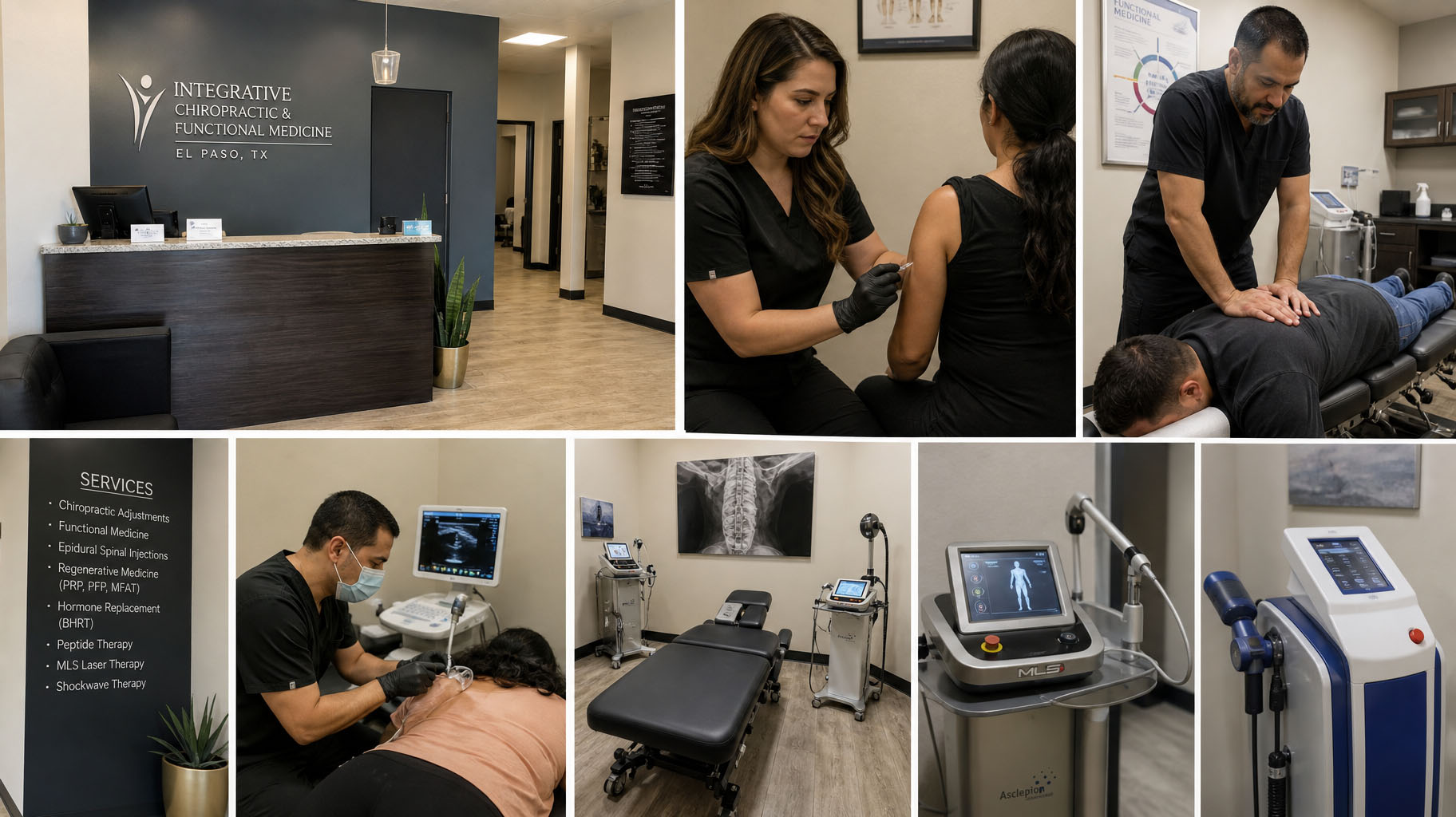
Injury Medical Clinic PA uses a multidisciplinary model. I serve as clinical director as a chiropractor and board-certified family nurse practitioner. Dr. Maria Guadalupe Cardenas, MD, is board-certified in internal medicine (NPI #1164426749, Texas MD License #J2933). She has more than 40 years of experience as an internist and serves as medical director and collaborative physician.
This setup is common in integrative and injury clinics. The MD provides medical direction, internal medicine risk review, and hormone oversight. The chiropractic and rehab team addresses alignment, soft tissue, auto-accident recovery, and return to work or sport. Functional medicine adds labs, nutrition, sleep, and gut-muscle links so the plan isn’t just a shot.
A person in this model may go through the following steps:
- Medical review of symptoms, medicines, fertility goals, and safety screens
- Targeted hormone and metabolic labs
- Chiropractic care for spinal and pelvic mechanics
- Rehabilitation for strength, balance, and daily demands
- Nutrition and recovery habits that support hormone work
- Follow-up labs for testosterone, hematocrit, and PSA when indicated
Main East Side clinic: 11860 Vista Del Sol, Suite 128, El Paso, TX 79936. Office: 915-850-0900 or 915-412-6677.
Who May Want This Option
SubQ testosterone may be worth a supervised talk when:
- Labs and symptoms support treatment, and the person can learn a home shot.
- Deep IM shots cause pain, fear, or missed doses.
- Pellets feel like too much commitment or are difficult to fine-tune.
- Gels are messy or raise transfer concerns at home.
- The goal is a steadier week, not a bigger peak.
It is a poor first choice when fertility is an immediate goal, when there is a prostate or breast cancer concern, when hematocrit is already high, or when a woman needs the route with the strongest female trial data. Those calls belong in the clinic.
Conclusion
The quiet case for the subcutaneous needle is a route fact, not a brand fact. Same ester. Different depot. Comparable average levels for many patients. A shot most people can keep doing. Pair that with scientific chiropractic care, and the aim isn’t just a better lab printout. The aim is a body that can still move.
This article is educational. The FDA does not review compounded medicines in the same way it reviews approved branded products. The prescribing clinician makes final treatment decisions after a full evaluation.
References
Bhasin, S., Brito, J. P., Cunningham, G. R., Hayes, F. J., Hodis, H. N., Matsumoto, A. M., Snyder, P. J., Swerdloff, R. S., Wu, F. C., & Yialamas, M. A. (2018). Testosterone therapy in men with hypogonadism: An Endocrine Society clinical practice guideline. The Journal of Clinical Endocrinology & Metabolism, 103(5), 1715–1744. https://doi.org/10.1210/jc.2018-00229
Cleveland Clinic. (n.d.). Subcutaneous testosterone injection.
Figueiredo, M. G., Gagliano-Jucá, T., & Basaria, S. (2022). Testosterone therapy with subcutaneous injections: A safe, practical, and reasonable option. The Journal of Clinical Endocrinology & Metabolism, 107(3), 614–626. https://doi.org/10.1210/clinem/dgab772
Hatzilabrou, T. A. (n.d.). The quiet case for the subcutaneous needle [White paper]. Worldborne Medical / Medivant Healthcare.
Jimenez, A. D. (n.d.). Clinical observations on hormone balance, subcutaneous dosing, and integrative chiropractic care. Injury Medical Clinic PA / Chiropractic Scientist.
Kaminetsky, J. C., McCullough, A., Hwang, K., Jaffe, J. S., Wang, C., & Swerdloff, R. S. (2019). A 52-week study of dose-adjusted subcutaneous testosterone enanthate in oil self-administered via disposable auto-injector. The Journal of Urology, 201(3), 587–594.
Mayo Clinic. (n.d.). Testosterone (intramuscular route, subcutaneous route).
Mulhall, J. P., Trost, L. W., Brannigan, R. E., et al. (2018). Evaluation and management of testosterone deficiency: AUA guideline. The Journal of Urology, 200(2), 423–432.
Optimale. (2024). How to do a subcutaneous testosterone injection.
Spratt, D. I., Stewart, I. I., Savage, C., Craig, W., Spack, N. P., Chandler, D. W., Spratt, L. V., Eimicke, T., & Olshan, J. S. (2017). Subcutaneous injection of testosterone is an effective and preferred alternative to intramuscular injection: Demonstration in female-to-male transgender patients. The Journal of Clinical Endocrinology & Metabolism, 102(7), 2349–2355.
Thimble Health. (n.d.). The hidden cost of needle fear: What healthcare systems overlook.
Comments are closed.