

Stress Headaches After MVA: Understanding the Causes

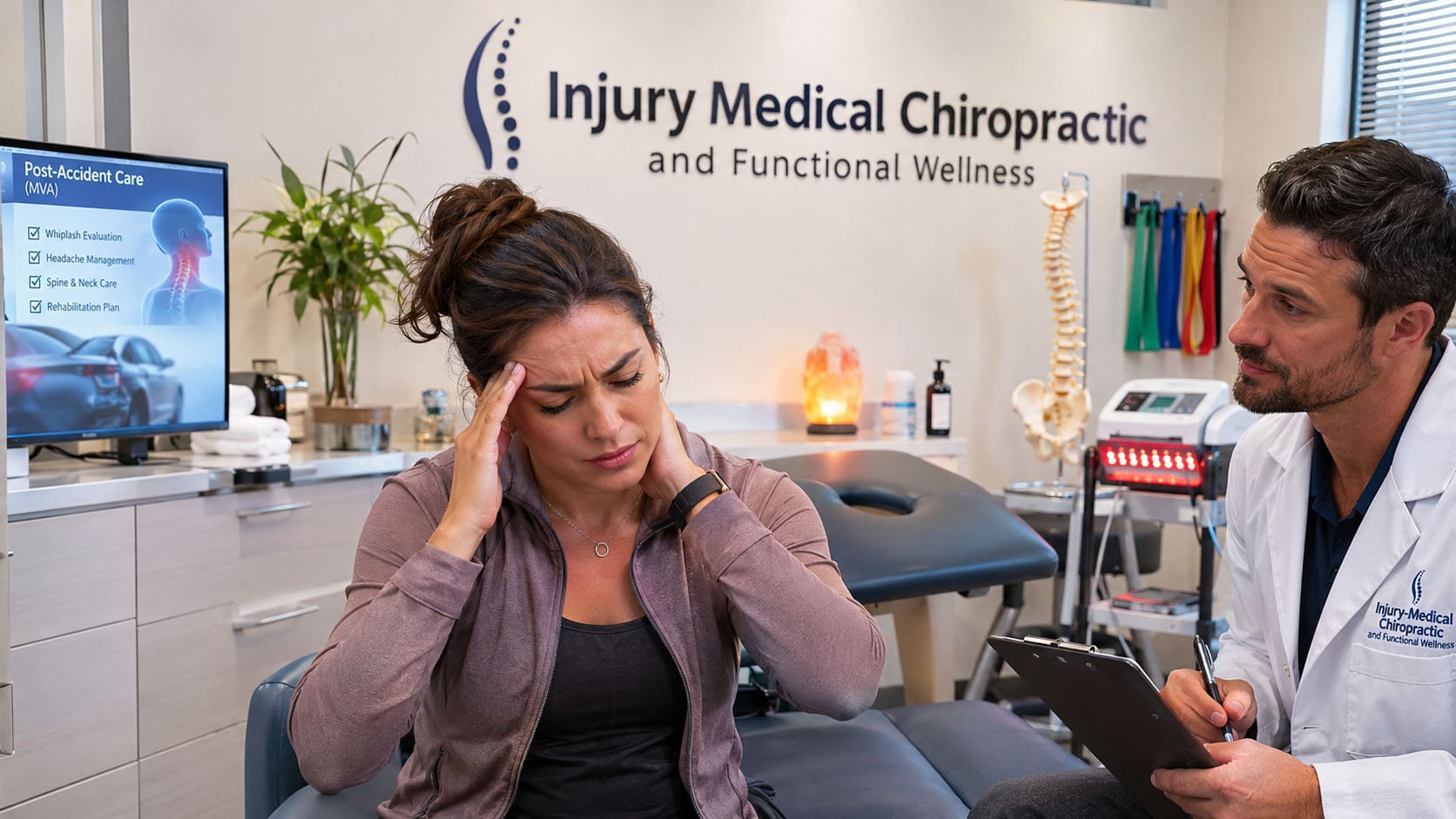
Documenting Stress Headaches After an MVA — Definition, Mechanism Link, and Treatment Overview for Claims
A driver on Loop 375 feels the sudden jolt of a rear-end impact. In the days that follow, a tight band of pressure wraps around the head, neck muscles stay guarded, and sleep becomes fragmented. Patients and attorneys often ask whether this “stress headache” is simply worry after the crash or a documented consequence of acceleration-deceleration forces acting on the cervical spine. Clear chronology, dual-provider notes, and objective findings answer that question for both recovery and careful causation analysis.

Defining Stress Headache in the Post-MVA Setting
People commonly describe a “stress headache” as a pressing or tightening sensation across the forehead, temples, or base of the skull. Clinically, this pattern most often matches tension-type headache: bilateral, mild-to-moderate intensity, without the throbbing quality, nausea, or strong light and sound sensitivity that define migraine. Pericranial muscle tenderness is frequently present. After a motor vehicle accident (MVA), the same features can appear or worsen. This is because the collision itself strained the cervical muscles, ligaments, and joints that share pain pathways with the head.
The International Classification of Headache Disorders notes that headaches following trauma or whiplash frequently resemble tension-type or migraine patterns. The sensation alone does not identify the source; the timing, mechanism, and examination findings do. When the band-like pain begins within days of a highway collision and is reproduced or worsened by neck movement or palpation of the upper cervical and trapezius muscles, the record supports a trauma-related contribution. Thus, it is not an unrelated primary headache.
Mechanism Link: Acceleration-Deceleration Forces and Cervical Muscle Strain
In a rear-end or sudden-deceleration crash, the torso moves forward while the head lags, then the head accelerates forward. This produces the classic sigmoid deformation of the cervical spine: lower segments flex while upper segments extend. The anterior longitudinal ligament, facet capsules, intervertebral discs, and neck-stabilizing muscles absorb the force. Suboccipital, upper trapezius, and levator scapulae fibers can develop protective spasm and myofascial trigger points. Nociceptive signals from these C1–C3 structures converge in the trigeminocervical complex and are perceived as head pain.
The result is not purely psychological stress. Muscle guarding, reduced cervical range of motion, and segmental tenderness create a mechanical driver for the tension-type pattern. Forward-head posture that often follows the injury further loads the same tissues, lowering the threshold for daily pressure or tightness. Dual-provider documentation captures this sequence. The chiropractic examination records digital range-of-motion losses and reproducible muscle findings, while the nurse practitioner or collaborating physician’s medical evaluation confirms the absence of red-flag neurological signs and co-documents the temporal link.
Chronology That Supports Both Recovery and Causation
A useful record follows a clear timeline:
- Day of collision and first 48–72 hours: Immediate neck stiffness or delayed onset of band-like head pressure. Early notes record the mechanism (rear-end on I-10 or Loop 375, estimated speed change if available) and any pre-existing headache history.
- First week: Objective findings include limited flexion-extension or rotation, tenderness over suboccipital and trapezius regions, and pain reproduced by cervical compression or sustained posture. Headache frequency or intensity is logged.
- Subsequent weeks: Serial measurements show whether motion improves, muscle tone decreases, and headache days decline with care. Functional notes track sleep disruption, concentration difficulty, or work limitations tied to the head and neck symptoms.
When dual-licensure providers co-sign these observations, the file demonstrates that the acceleration-deceleration event produced measurable soft-tissue injury capable of generating or aggravating the tension-type pattern. If a pre-existing tendency to muscle tension or occasional headaches existed, the Texas Eggshell Plaintiff rule still applies. Thus, the responsible party is accountable for the aggravation caused by the collision, not for the baseline vulnerability itself. Timed, objective data isolate the traumatic contribution.
These records strengthen proof of causation in car accident cases, as outlined in the master guide on establishing medical-legal causation at dralexjimenez.com.
Treatment Overview Focused on What Patients Gain
Care targets the cervical drivers while supporting overall recovery. Spinal adjustments and mobilization restore segmental motion, reducing the mechanical load that feeds head pain. Soft-tissue techniques and therapeutic exercise deactivate trigger points and improve posture endurance. Neurofunctional acupuncture, or electroacupuncture, can calm overactive muscle tone and support nervous-system recovery. As a result, there are often better sleep and fewer pressure-type headache days.
Patients typically gain reduced band-like pressure, increased ability to turn the head without triggering pain, improved sleep continuity, and greater tolerance for daily activities such as driving or desk work. The approach remains non-invasive and drug-sparing, lowering the risk of reliance on frequent analgesics. Coordination with the patient’s existing medical team ensures any co-existing factors (sleep, metabolic contributors, or concurrent migraine features) are addressed without conflicting recommendations.
For a broader view of how post-traumatic and stress-related patterns are differentiated and managed, see the integrated headache management overview of seven patterns at dralexjimenez.com and the detailed explanation of post-traumatic headaches after accidents at dralexjimenez.com/post-traumatic-headaches-after-accidents-causes-explained. Additional causation insights linking chiropractic findings to headache mechanisms appear at dralexjimenez.com.
Bioethical Pillars in Documentation and Care
Beneficence is served by evidence-based recovery that addresses the actual tissue drivers identified on examination. Combining structural care with functional tracking produces measurable improvement in pain and daily capacity rather than symptom masking alone.
Non-maleficence requires accurate attribution. Dual-provider notes distinguish trauma-related muscle strain and motion loss from unrelated primary headache or red-flag conditions that need urgent referral. Non-invasive options reduce the likelihood of unnecessary medication escalation or premature invasive procedures.
Autonomy is supported when patients and their counsel receive the same clear chronology and objective data. Shared records allow informed decisions about continued care, work modifications, or settlement considerations without hidden findings.
What Makes the Clinic Distinct in El Paso
Injury Medical Clinic PA is led by a medical director, Dr. Maria Guadalupe Cardenas, MD, Board Certified in Internal Medicine, who provides clinical direction for complex presentations and risk stratification. Working alongside her is Dr. Alex Jimenez, DC, APRN, FNP-BC, a dual-licensed provider whose nurse-practitioner scope specializes in soft-tissue injury evaluation and management. This combination of medical direction and soft-tissue expertise within one integrated practice is one of the only clinics in El Paso, TX, that delivers these coordinated treatments under dual-licensure co-documentation. The result is courtroom-ready notes that simultaneously guide recovery and withstand scrutiny on mechanism and causation.
Attorneys handling highway-trauma claims involving ongoing head pain benefit from files that contain the chronological mechanism link, objective cervical findings, and dual-provider signatures. Patients benefit from care that reduces the mechanical drivers of the pressure-type headache while preserving autonomy through transparent records. When the chronology is clear and the measurements are reproducible, post-MVA stress headache is no longer an ambiguous complaint; it becomes a documented, treatable consequence of collision forces.
References
Headache Classification Committee of the International Headache Society. (2018). The International Classification of Headache Disorders, 3rd edition. Cephalalgia, 38(1), 1–211. doi.org/10.1177/0333102417738202
Sterling, M., Elliott, J. M., & Cabot, P. J. (2019). The course of acute and chronic pain after motor vehicle collision. Pain, 160(Suppl 1), S4–S10. doi.org/10.1097/j.pain.0000000000001381
Ashina, S., Bendtsen, L., Lyngberg, A. C., Lipton, R. B., Hajiyeva, N., & Jensen, R. (2015). Prevalence of neck pain in migraine and tension-type headache: A population study. Cephalalgia, 35(3), 211–219. doi.org/10.1177/0333102414535110
Al-Khazali, H. M., Younis, S., Al-Sayegh, Z., Ashina, S., Ashina, M., & Schytz, H. W. (2022). Prevalence of neck pain in migraine: A systematic review and meta-analysis. Cephalalgia, 42(7), 663–673. doi.org/10.1177/03331024221082506
Trager, R. J., Daniels, C. J., Meyer, K. W., Stuber, K. J., & Dusek, J. A. (2026). Clinical practice guideline for the chiropractic treatment of adults with headache. Journal of Manipulative and Physiological Therapeutics. Advance online publication. doi.org/10.1016/j.jmpt.2025.12.001
Comments are closed.