
Documented Decompression Laser Causation Explained
Why Documented Use of Decompression, MLS Laser, and Shockwave Therapy Supports Causation and Future-Care Costs
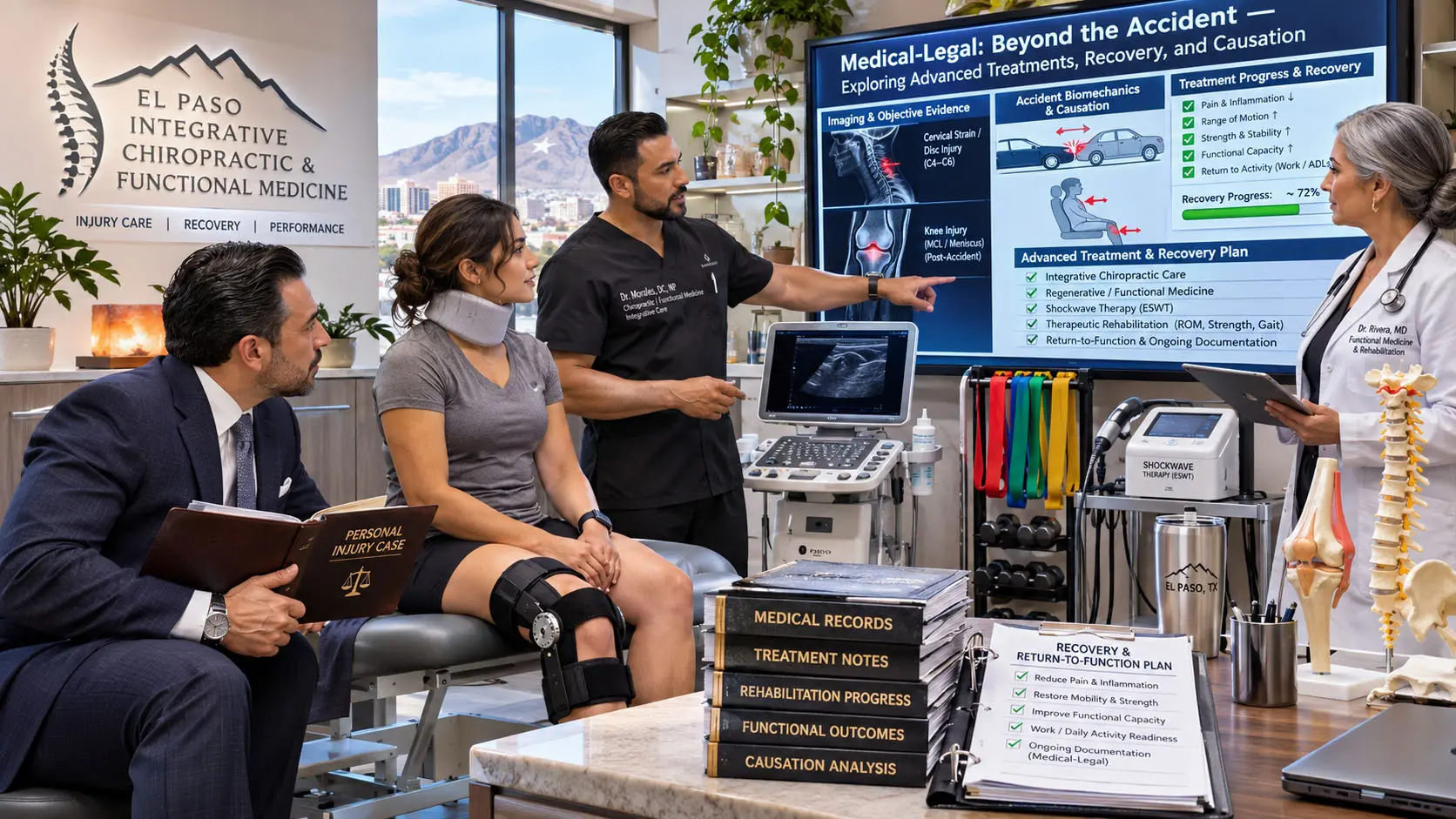
Attorneys handling El Paso personal injury claims often face reduction arguments that treat non-invasive care as optional or temporary. When progress notes document spinal decompression, MLS laser (photobiomodulation), and shockwave therapy with measurable response data, those modalities become evidence of ongoing traumatic impairment and medically necessary future care under a Letter of Protection.
Why Objective Documentation Matters for Special Damages
Defense experts frequently characterize soft-tissue treatment as palliative once acute pain improves. Objective records that track mechanical unloading, cellular response, and functional change after collision forces on I-10 or Loop 375 corridors make that argument harder to sustain. The notes show why the body still requires restorative input, not merely why the patient still reports symptoms.
- Parameter-based notes reduce vulnerability to Colossus-style reductions.
- Dated response data link residual deficits to the collision mechanism under the Texas Eggshell Rule.
- Transparent records travel cleanly with the LOP file and support future-care projections.
Spinal Decompression: Documenting Mechanical Unloading
Spinal decompression applies controlled, intermittent traction to reduce intradiscal pressure and improve nutrient exchange in compressed segments. When flexion-extension findings or digital range-of-motion data already establish traumatic aggravation, decompression sessions then document whether unloading produces measurable improvement.
Key elements captured in progress notes include:
- Force parameters and cycle settings used during each session
- Patient tolerance and any symptom provocation or relief
- Changes in end-range motion, pain with specific movements, or functional scores
- Serial comparison showing residual loading that has not fully resolved
These entries demonstrate that residual disc or facet loading continues to limit recovery. The pattern supports both the causal connection to the collision and the projected need for continued or intermittent unloading care.
MLS Laser Therapy: Capturing Cellular and Inflammatory Response
MLS laser therapy delivers synchronized dual wavelengths (typically 808 nm continuous and 905 nm pulsed) to support photobiomodulation. The process targets mitochondrial activity, local inflammation, and tissue repair without thermal damage.
Documentation that strengthens the causation file includes:
- Energy density (J/cm²) delivered to each anatomic site
- Immediate and cumulative response data (reduced swelling, improved tissue glide, lower pain with movement)
- Dates that tie the treatment timeline to the collision
- Evidence of progressive but incomplete resolution of soft-tissue impairment
When the response curve shows measurable gains yet residual deficits remain, attorneys can use the record to counter claims that further care is merely elective and to justify including photobiomodulation in future-care cost projections.
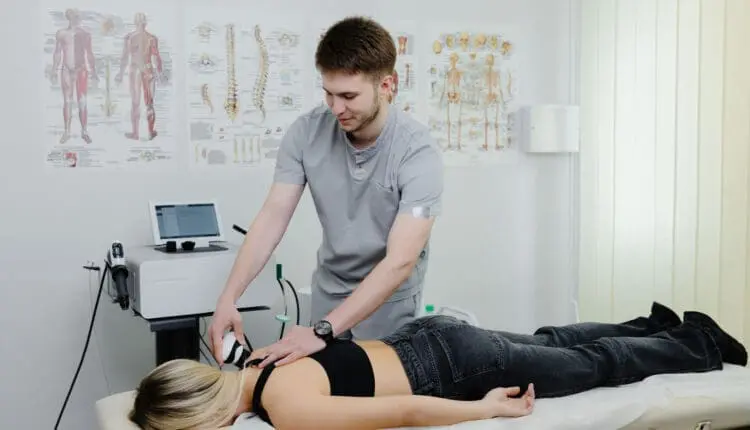
Shockwave Therapy: Tracking Soft-Tissue Remodeling
Shockwave therapy (extracorporeal shockwave therapy or radial pressure-wave application) uses acoustic pulses to stimulate mechanotransduction, collagen remodeling, and local circulation in tendons, fascia, and muscle.
Progress notes that protect special damages typically record:
- Intensity, frequency, and anatomic targets for each session
- Pre- and post-session changes in tenderness, mobility, or strength
- Measurable gains paired with persistent limitations in load tolerance or trigger points
- Timeline showing the tissue has not returned to pre-collision capacity months after impact
This pattern illustrates that continued or intermittent sessions address a documented traumatic deficit rather than a pre-existing condition.
How the Three Modalities Work Together in the Record
When used and documented together, the modalities create a longitudinal picture of ongoing impairment:
- Decompression addresses mechanical loading of discs and joints.
- MLS laser addresses cellular energy and inflammatory barriers.
- Shockwave addresses stubborn soft-tissue remodeling and adhesions.
Objective progress notes and response data for each modality show why the impairment remains causally related to the trauma and why stopping care would leave measurable deficits unaddressed. The combined record is harder for defense experts to dismiss as excessive or unrelated.
Bioethical Foundations of Documented Non-Invasive Care
The approach rests on three practical pillars:
- Beneficence: Restorative options directly address documented deficits rather than relying on symptom suppression alone.
- Non-Maleficence: Drug-free, lower-risk pathways avoid prolonged medication or premature surgical intervention while still targeting the mechanical and cellular consequences of rapid deceleration.
- Autonomy: Patients and counsel receive transparent billing summaries and shared treatment records so decisions about continued care under the LOP are informed and aligned.
What Makes the Clinic’s Documentation Unique
Injury Medical Clinic PA in El Paso operates under the medical direction of Dr. Maria Guadalupe Cardenas, MD, a board-certified internal medicine physician with more than forty years of experience. Dr. Alex Jimenez, DC, APRN, FNP-BC, CFMP, IFMCP, is dual-licensed as both a chiropractor and a board-certified family practice nurse practitioner with prescriptive authority. His clinical focus includes soft-tissue injury and the advanced non-invasive modalities described here. This dual-licensure model produces a single coordinated record in which chiropractic findings, nurse-practitioner evaluation, and medical oversight appear together. The clinic is one of the only practices in El Paso that routinely provides spinal decompression, MLS laser, and shockwave therapy within an integrated personal-injury protocol under medical direction.
Further clinical detail on these modalities appears in related discussions of MLS laser protocols, extracorporeal shockwave application for motor-vehicle soft-tissue injuries, and non-surgical spinal decompression methods on the clinic’s primary site at dralexjimenez.com.
This modality documentation is detailed in the proving causation in car accident cases methodology at dralexjimenez.com.
Call to Action
Attorneys seeking courtroom-ready records that protect special damages and support future-care projections under LOP can request a coordinated evaluation. Contact Injury Medical Clinic PA in El Paso to review how documented decompression, MLS laser, and shockwave response data can strengthen your causation file. Coordinated dual-licensure notes are available for attorney review upon request.
References
Simplicio, C. L., Purita, J., Murrell, W., Santos, G. S., Dos Santos, R. G., & Lana, J. F. S. D. (2020). Extracorporeal shock wave therapy mechanisms in musculoskeletal regenerative medicine. Journal of Clinical Orthopaedics and Trauma, 11(Suppl 3), S309–S318. doi.org/10.1016/j.jcot.2020.02.004
Yoon, S. H., Kim, Y. H., & Park, J. H. (2023). The role of extracorporeal shockwave therapy in muscle injuries. Cureus, 15(4), e37234. doi.org/10.7759/cureus.37234
Hamblin, M. R. (2016). Photobiomodulation or low-level laser therapy. Journal of Biophotonics, 9(11–12), 1122–1124. doi.org/10.1002/jbio.201670113
World Association for Laser Therapy. (2023). WALT dosage recommendations. waltpbm.org/documentation-links/recommendations
Ramos, G., & Martin, W. (1994). Effects of vertebral axial decompression on intradiscal pressure. Journal of Neurosurgery, 81(3), 350–353. doi.org/10.3171/jns.1994.81.3.0350
Wang, S., Li, J., & Zhang, Y. (2022). Non-surgical spinal decompression for lumbar disc herniation: A systematic review. Journal of Orthopaedic Surgery and Research, 17(1), 112. doi.org/10.1186/s13018-022-03000-1
Choi, J., Lee, S., & Kim, H. (2022). Clinical outcomes of motorized spinal decompression therapy in patients with discogenic pain. Journal of Physical Therapy Science, 34(5), 345–351. doi.org/10.1589/jpts.34.345
Comments are closed.