

Post-Injury Headache Documentation: Key Considerations

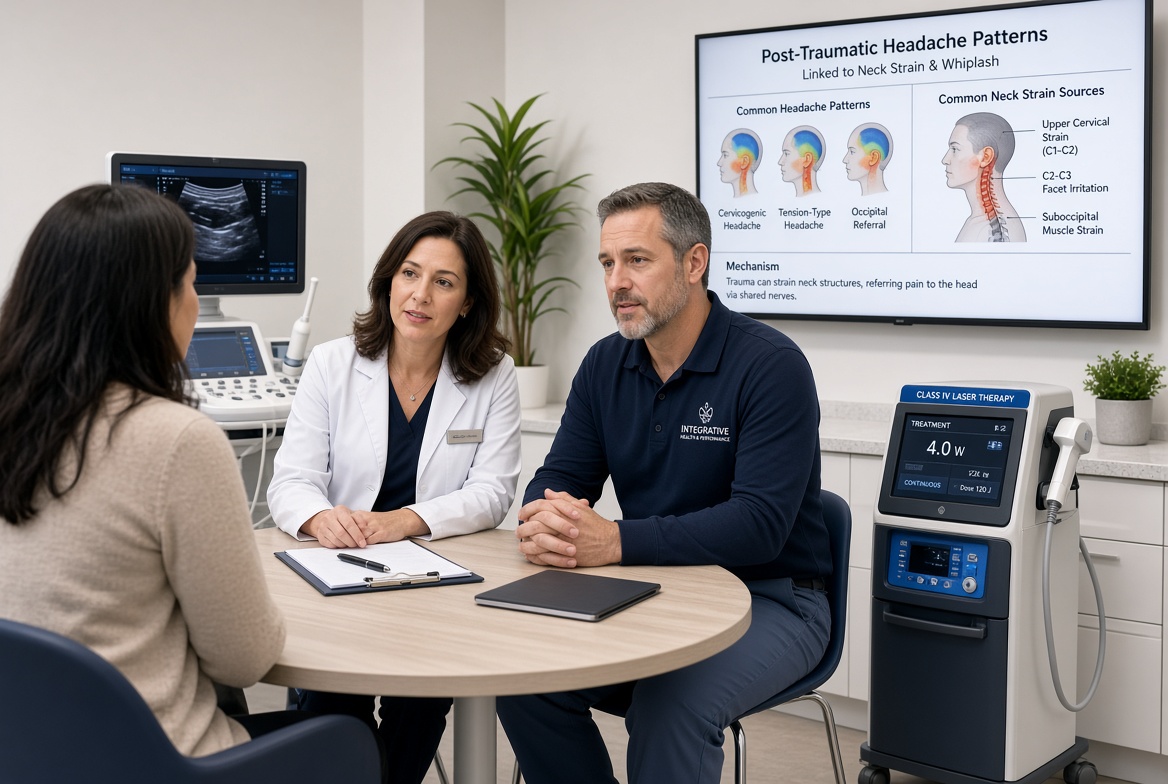
Documenting Post-Injury Headaches After a Collision — Accurate Categories and Treatment Awareness for Claims
A driver on I-10 or Loop 375 feels the sudden jolt of a rear-end impact. Hours later, the neck stiffens. By the next morning, a steady pressure sits at the base of the skull and spreads forward. Some patients describe the pain as a tight band; others report throbbing, light sensitivity, or pain that worsens when they turn their head. For attorneys and patients alike, the first practical question is not simply “Does the headache hurt?” Instead, it’s “What kind of post-injury headache is this?” and “When did it start?” In addition, “What objective record shows both the recovery path and the careful link to the collision?”
The International Classification of Headache Disorders (ICHD-3) provides clear categories that help answer that question. Headache attributed to whiplash develops within seven days of the acceleration-deceleration event. It is labeled acute when it lasts less than three months. When the same headache continues beyond three months, it may meet the criteria for persistent headache attributed to whiplash. Parallel rules apply to headache attributed to traumatic injury to the head. These time windows matter because they separate a new secondary headache from an unrelated primary headache. The latter simply happened to appear later.

Post-injury headache is not one single phenotype
After the same collision, a patient may develop a migraine-like pattern (throbbing pain, nausea, sensitivity to light or sound), a tension-type pattern, or a cervicogenic headache driven by upper-cervical joints and soft tissues. They could also experience occipital neuralgia or a mixed picture. Accurate notes record the location, quality, triggers, associated neck findings, and how the pattern changed from the first days after the crash. That phenotype description helps both the treating team and later reviewers understand why a particular treatment approach was chosen. It also shows why the headache is not dismissed as “just stress.”
Chronology is the backbone of careful documentation. A complete record begins with the pre-injury baseline: how often headaches occurred, how severe they were, and what functional limits existed before the collision. It then captures the mechanism—rapid deceleration, head position at impact, and whether the head struck a headrest or object. The record also includes the timing of first headache symptoms relative to that event. Serial notes track frequency, intensity, duration, and functional impact (work, driving, sleep, concentration) at regular intervals. Objective findings such as restricted cervical range of motion and reproduction of the familiar headache with specific neck movements or compression tests are important. Measured changes in soft-tissue tenderness provide measurable timeline anchors. When dual-provider notes from the soft-tissue specialist and the medical director sit side by side, the file shows both the structural recovery path and the medical safety screen. The latter ruled out red-flag conditions.
What Dual-Provider Documentation Supports
Dr. Alex Jimenez, DC, APRN, FNP-BC, focuses on the mechanical and soft-tissue side: digital range-of-motion measurements, segmental findings in the upper cervical and suboccipital regions, response to gentle chiropractic care, electroacupuncture, and functional progress. Dr. Maria Guadalupe Cardenas, MD, as Medical Director, oversees the broader medical picture—neurological screening, review of possible contributing metabolic or inflammatory factors, and coordination when additional imaging or specialist input is indicated. Together, the notes document:
- Clear onset timing consistent with ICHD-3 windows
- Phenotype details that distinguish cervicogenic, migraine-like, or mixed patterns
- Objective cervical and functional findings that change over time
- Safety screening that protects the patient and the integrity of the record
This dual record supports evidence-based recovery while remaining careful about causation. Temporal association and a plausible mechanism (acceleration-deceleration loading of cervical ligaments, facet capsules, and the trigeminocervical complex) are necessary but not sufficient by themselves. The notes show how the team evaluated the findings against alternative explanations. Furthermore, they detail how the team made treatment decisions for the patient’s benefit.
Bioethical Roadmap in Practice
Beneficence is served when the team selects interventions that match the documented phenotype and measured limitations. Patients gain reduced headache frequency, improved neck mobility, better sleep, and the ability to return to daily activities when care addresses both the cervical contributors and any broader recovery needs. Non-maleficence is protected by deliberate safety screening and accurate attribution. Red-flag symptoms prompt prompt medical evaluation rather than delayed care. Also, the record does not overstate what the findings can prove. Autonomy is honored when the patient receives clear explanations of the categories, the timeline, and the treatment options. When those same records are shared with counsel, the patient can make informed decisions about both health care and the legal claim.
At Injury Medical Clinic PA in El Paso
The combination of a board-certified internal medicine medical director and a dual-licensed soft-tissue specialist who is also an advanced practice registered nurse is uncommon. The clinic is one of the only facilities in El Paso that integrates these dual scopes under one roof for post-collision headache evaluation and recovery. Patients and attorneys therefore receive coordinated notes that support both clinical progress and careful causation analysis. They benefit without stitching records from separate offices.
These records strengthen causation evidence in car accident cases at dralexjimenez.com. Related discussions appear in the integrated headache management patterns guide (dralexjimenez.com). Further information is in the causation insights for chiropractic care of headaches (dralexjimenez.com) and the complete clinical guide to integrated migraine and post-traumatic headache evaluation (dralexjimenez.com). Additional context on post-accident headache patterns is available at dralexjimenez.com/post-accident-headaches-in-el-paso-pain-relief. There is also information on medical-legal causation opinions at dralexjimenez.com.
When the chronology, phenotype notes, and dual-provider findings are documented consistently, attorneys receive a file that supports both the patient’s recovery and a defensible analysis of how the collision relates to the headaches that followed. Patients receive care aimed at restoring function while remaining fully informed about what the record does—and does not—claim.
References
Headache Classification Committee of the International Headache Society (IHS). (2018). The International Classification of Headache Disorders, 3rd edition. Cephalalgia, 38(1), 1–211. doi.org/10.1177/0333102417738202
International Headache Society. (2018). 5.3 Acute headache attributed to whiplash. In The International Classification of Headache Disorders, 3rd edition. ichd-3.org/5-headache-attributed-to-trauma-or-injury-to-the-head-andor-neck/5-3-acute-headache-attributed-to-whiplash
International Headache Society. (2018). 5.4 Persistent headache attributed to whiplash. In The International Classification of Headache Disorders, 3rd edition. ichd-3.org/5-headache-attributed-to-trauma-or-injury-to-the-head-andor-neck/5-4-persistent-headache-attributed-to-whiplash
International Headache Society. (2018). 5.2 Persistent headache attributed to traumatic injury to the head. In The International Classification of Headache Disorders, 3rd edition. ichd-3.org/5-headache-attributed-to-trauma-or-injury-to-the-head-andor-neck/5-2-persistent-headache-attributed-to-traumatic-injury-to-the-head
Sterling, M., Hendrikz, J., & Kenardy, J. (2011). Similar factors predict disability and posttraumatic stress disorder trajectories after whiplash injury. Pain, 152(6), 1272–1278. doi.org/10.1016/j.pain.2011.01.056
Comments are closed.