
Integrative Wellness Plan: Beyond Temporary Relief
An Integrative Wellness Plan for Accident and Work Injuries: Restoring Mobility Through Layered Care
Accident and work injuries often leave more than just pain. Soft tissues stretch or tear. Ligaments loosen. Discs may bulge. Nerves become irritated. Simple rest and pain pills rarely resolve the full problem. An integrative wellness plan provides a clearer path. It combines structural care, cellular repair, and nutritional support. The goal is faster healing and lasting mobility, not just temporary relief.
This approach moves through clear phases. First, it calms inflammation. Next, it realigns the structure. Then it rebuilds damaged tissue. Finally, it restores strength and function. Providers layer mechanical corrections with biological tools and systemic support. The result is calmer nerves, stronger ligaments and discs, and better spinal mechanics.

Why Traditional Care Often Falls Short
After a car crash or workplace strain, the body starts its repair process. Swelling protects the area. Scar tissue forms. Muscles tighten to guard the injury. Without guidance, these changes can lock in stiffness and pain. Standard care may mask symptoms with medication or recommend surgery for stubborn cases. Yet many people still face limited movement months later.
An integrative plan works differently. It supports the body’s natural repair systems at every stage. Structural care from chiropractic adjustments and spinal decompression restores alignment. Regenerative procedures such as platelet-rich plasma (PRP) and micro-fragmented adipose tissue (MFAT) deliver growth factors directly to injured areas. Intravenous (IV) nutrients supply the building blocks cells need. Together, these steps address the injury from the outside and the inside.
Phase 1: Calming Inflammation and Protecting the Area
The first days and weeks after injury focus on reducing swelling and quieting irritated nerves. Gentle chiropractic adjustments restore joint motion without forcing the body. Soft-tissue techniques ease muscle guarding. Spinal decompression gently lowers pressure on discs and nerve roots. These steps create space for healing to begin.
Laser therapy and shockwave therapy are often included in the plan here. Class 4 laser light penetrates tissue and boosts cell energy production. It lowers inflammatory signals and speeds early repair. Shockwave therapy sends acoustic waves that improve blood flow and break up early scar tissue. Both tools prepare the ground for deeper healing.
IV nutrient support can also start early. Direct delivery of vitamins, minerals, and antioxidants helps cells fight oxidative stress. Better cellular energy means the body can clear inflammation more efficiently.
Phase 2: Restoring Structural Alignment
Once acute swelling settles, the focus shifts to mechanical balance. Chiropractic care corrects joint restrictions and improves spinal curves. Spinal decompression creates gentle traction that encourages disc hydration and reduces nerve pressure. These corrections take load off injured ligaments and discs so new tissue can form in a healthy position.
Dr. Alexander Jimenez, DC, APRN, FNP-BC, CFMP, IFMCP, ATN, has observed that biomechanical problems and tissue damage travel together. When alignment stays off, even strong regenerative signals struggle. Correcting the “soil” of posture and joint motion allows the biological “seed” of growth factors to work more effectively.
Rehabilitation exercises begin at a light level in this phase. Simple movements retrain muscles that have gone offline. The goal is steady progress without reinjury.
Phase 3: Stimulating Tissue Regeneration
Stubborn soft-tissue damage, ligament laxity, or bulging discs often need extra help. Regenerative procedures are often needed. PRP starts with a simple blood draw. The sample is spun to concentrate platelets and growth factors. When injected under imaging guidance, these factors signal cells to repair and rebuild. Research and clinical experience show PRP works well for mild-to-moderate tendon and ligament injuries as well as early disc problems.
MFAT uses a small amount of the patient’s own fat tissue. Gentle processing creates fragments rich in supportive cells and growth factors. These fragments provide cushioning and a longer-lasting repair signal. MFAT suits larger joints, cartilage issues, and more complex soft-tissue damage.
Some clinics also use bone-marrow aspirate concentrate when deeper regenerative cell support is needed. The choice depends on the injury’s location, severity, and the patient’s goals. All of these options use the patient’s own tissue, which keeps the risk of reaction low.
Lasers and shockwave therapy continue to support this phase. They improve circulation around the injection site and help the growth factors reach their targets. The combination creates a stronger healing environment than any single tool alone.
Phase 4: Building Functional Strength and Preventing Relapse
The final phase turns repaired tissue into reliable function. Progressive rehabilitation strengthens stabilizers around the spine, shoulders, hips, and knees. Balance and posture training reduce the chance of future injury. Functional medicine looks at sleep, nutrition, and stress to keep the whole system ready to heal.
Patients gradually return to work tasks, driving, and daily activities. Follow-up visits track range of motion, strength, and pain levels. Clear documentation supports personal-injury or workers’-compensation claims when needed.
How the Multidisciplinary Team Works Together
At Injury Medical Clinic PA in El Paso, Texas, this layered plan is carried out by a coordinated team. Dr. Alexander Jimenez provides chiropractic care, functional-medicine guidance, and advanced regenerative options. He brings dual training as a chiropractor and nurse practitioner, allowing him to address both structural and medical aspects of injury.
Dr. Maria Guadalupe Cardenas, MD, board-certified in internal medicine (NPI #1164426749, Texas MD License #J2933), serves as medical director and collaborative physician. With more than 40 years of experience as an internist, she provides medical oversight, reviews complex cases, and ensures patient safety across the care plan. This MD–DC collaboration is common in modern integrative injury clinics. The medical director supports diagnostic decisions, medication review when appropriate, and the safe use of regenerative procedures.
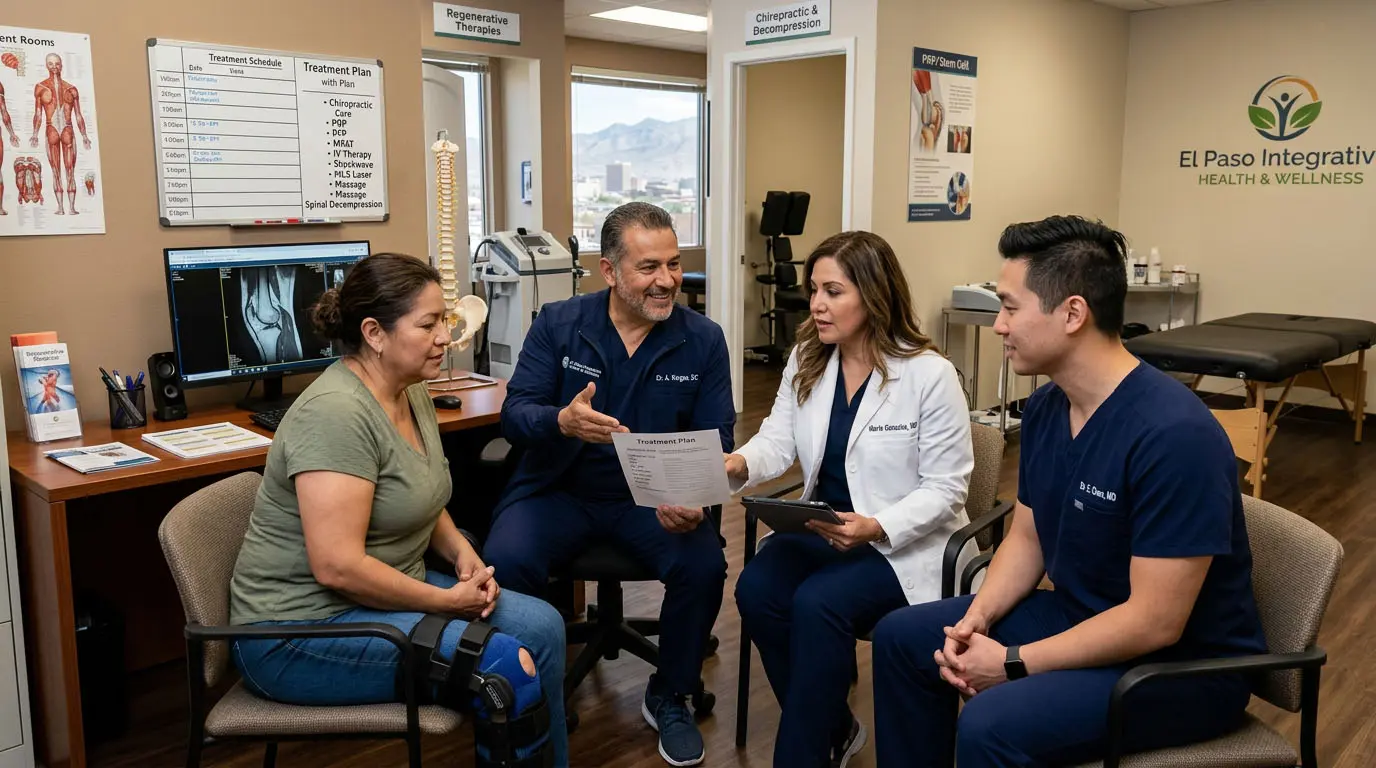
The team also includes rehabilitation specialists and functional-medicine support. Together, they create a single coherent plan rather than separate appointments that never communicate with each other. Patients receive structural corrections, cellular repair tools, and nutritional support under one roof.
Benefits Patients Notice
People who follow an integrative plan often report:
- Faster drop in pain and swelling
- Improved sleep and daily energy
- Greater confidence in movement
- Less need for long-term medication
- Lower chance of chronic stiffness or instability
Because the plan works with the body’s own repair systems, results tend to last. Structural alignment keeps new tissue from being overloaded. Regenerative signals continue to strengthen tissue for months after the injections. Nutritional support maintains a favorable cellular environment.
When Regenerative Options Become Especially Helpful
Rest, basic therapy, and time solve many injuries. When soft-tissue damage or disc problems linger, regenerative procedures offer a next step before surgery is considered. Imaging and clinical findings guide the decision. The same careful evaluation also shows when simple structural care is still enough.
Providers aim to manage pain in the short term while stimulating natural repair for the long term. That dual focus is the heart of the integrative approach.
A Clear Path Forward
An integrative wellness plan for accident or work injuries does not rely on one magic treatment. It layers mechanical corrections, biological repair, and systemic support in a logical order. Inflammation settles. Structure improves. Tissue rebuilds. Function returns. Under the guidance of experienced clinicians such as Dr. Alexander Jimenez and Dr. Maria Guadalupe Cardenas, patients in El Paso receive coordinated care that addresses the full scope of their injuries.
If you are dealing with lingering pain or limited mobility after an accident or workplace strain, a thorough evaluation can show which combination of therapies fits your situation. Early, layered care provides the body its best chance to heal completely and return to the activities that matter most.
References
Close, M. (2026, February 26). Comparing PRP, BMAC, and MFAT: Choosing the right regenerative treatment. Sports Medicine of the Rockies.
El Paso Back Clinic. (n.d.). Regenerative therapies combined with chiropractic for pain relief.
El Paso Back Clinic. (n.d.). Integrative chiropractic clinics help personal injury claims.
El Paso Chiropractor Blog. (2026, July). Arm and shoulder injuries after auto accidents: How integrative care supports recovery.
Health Coach Clinic. (n.d.). Regenerative medicine options for spinal health.
Health Coach Clinic. (n.d.). Regenerative medicine and integrative chiropractic approaches.
Jimenez, A. (n.d.). How PRP composition influences your healing journey.
New Regen Ortho. (n.d.). Chiropractors: How to integrate regenerative medicine into your practice the right way.
Push as RX. (n.d.). Healing after a car crash with regenerative therapies.
Sciatica Clinic. (n.d.). Integrated treatment solutions: Healing after accidents.
Sciatica Clinic. (n.d.). Integrated posture care combining multiple therapies.
Apex Biologix. (n.d.). Why regenerative therapies belong in chiropractic practices.
Harrington, P. (n.d.). Comparing Class 4 laser therapy, PEMF, and shockwave treatments in chiropractic care.
Integrative Wellness IV. (n.d.). Integrative wellness IV therapy.
Comments are closed.