

PRP Appointment in El Paso for Injury Recovery

What a PRP Appointment in El Paso Actually Looks Like if You Work Nights
Abstract
If you work nights on a fulfillment floor or in an NOC, a platelet-rich plasma visit is an office appointment, not a hospital day. This guide covers the blood draw, centrifuge, ultrasound, drive-home rules, 72-hour soreness, and written work limits.
You finish a night shift with a shoulder that still catches when you reach, or a knee that stiffens after hours on concrete. Someone mentioned PRP. Before you book, you need three answers: how long you will be in the chair, whether you can drive yourself home, and whether you can return to the floor or the NOC chair without leaving a hole in the injury record. This is a plain walk-through of that day and why the paperwork is important.
Why a night schedule changes the visit
PRP uses a concentrated portion of your blood. Platelets help a cut clot. Packed more tightly and placed into an injured tendon or joint, they release signals that can support local repair (Nadeau-Vallée et al., 2025). Results are not guaranteed. Evidence is stronger as a second-line option after rest, therapy, and load changes, and it is mixed across body regions (Ye et al., 2025; Eliasberg et al., 2025).
Night work adds three practical problems: you may arrive dehydrated and short on sleep; your next shift may land inside the 48- to 72-hour sore window; and floor work is not console work, so “return to work” cannot be one sentence. Those details belong in the note, not in a hallway chat.
Before you walk in
A responsible clinic examines first. Expect a focused exam, a review of imaging if you have it, and a consent form in ordinary language. If this visit is part of a motor-vehicle or work-injury case, bring the injury date and mechanism, current job demands, medicines (especially anti-inflammatory pills), and prior therapy notes.
Many night workers take ibuprofen or naproxen for shift aches. Those medicines can interfere with platelet signaling. Your clinician will tell you which medications to hold and for how long. Do not stop a prescribed blood thinner on your own. If you carry group insurance through a local employer, ask what the plan requires for authorization. Coverage varies. If you just finished your shift, eat something light, drink water, and consider getting a ride home.
The blood draw
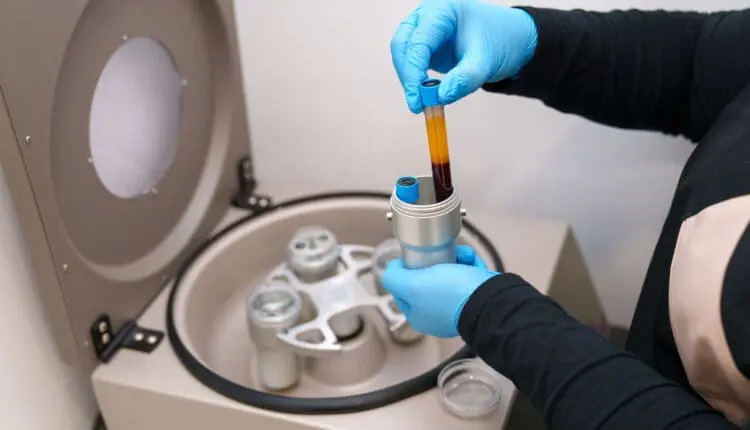
This part looks like a regular lab visit. A team member draws blood from a vein in your arm. The volume is larger than a routine test—often a few tablespoons—but it is still an office draw and usually takes five to ten minutes. Tell the staff if you feel lightheaded. Night workers who skipped food and stacked energy drinks are the ones who fade in the chair. That is physiology, not weakness. The tubes go into a centrifuge. You stay in the clinic.
The centrifuge wait
The machine spins the blood so heavier cells drop, and a platelet-rich layer can be separated. That wait is often 10 to 30 minutes. You are not under anesthesia. You should not leave the building.
Use the wait to confirm where the injection will go and what you may do with that body part for the next three days. If you are documenting a work injury or crash, ask that the planned target and the reason for choosing PRP be written in language a claims reviewer or attorney can read later.
Ultrasound and the injection
Most musculoskeletal PRP injections here are done with ultrasound so the needle can be watched in real time. The skin is cleaned. Local numbing medicine is often used. You will feel pressure more than a sharp cut. The injection itself is brief.
Ultrasound is a safety tool, not theater. It also creates an image record that can sit beside your exam. That matters when someone later asks whether the treated structure matches the original injury. You rest for a few minutes. The team checks the site, reviews aftercare, and answers the drive-home question before you stand up.
Drive-home rules
Usually, there is no general anesthesia and no hospital stay. Many people drive themselves after a simple, well-numbed joint or tendon injection if they feel steady, can use the pedals and wheel safely, and did not receive sedating medicine.
Do not drive if you are too tired from a night shift to make a safe emergency stop, if the treated limb is the one you need for the brake or steering, if you received medicine that clouds alertness, or if pain makes you compensate in a way you would not accept from a coworker. A ride is a do-no-harm decision: do not add a second injury on I-10 to the first one.
The first 72 hours
Soreness, stiffness, and a deep ache at the site are common for two to five days. Some people feel worse before they feel better. That flare is often the expected inflammatory phase, not proof the visit failed (Eliasberg et al., 2025).
Typical first-three-day rules: protect the treated area from heavy load; use ice if directed; use acetaminophen if allowed; avoid anti-inflammatory pills unless your medical team says otherwise; keep the site clean; skip pools; and do not test the joint with a hero shift.
Hydration and sleep matter more than another energy drink. Call the clinic for fever, spreading redness, rapidly worsening swelling, new numbness, or pain that is clearly different from the expected ache.
Back to the floor or the NOC chair
Return-to-work is about job demand, not job title.
Fulfillment or warehouse floor. Walking, pallet work, overhead reach, repeated gripping, ladders, and sudden lifts are high demand. Many people need modified duty for at least a few days. “I can walk” is not the same as “I can throw boxes for ten hours.”
NOC chair or console work. Sitting and headset time are lower demand, but not zero. A treated shoulder or elbow can still flare after six hours of keyboarding. A treated hip or low back can stiffen in a poorly set chair.
Ask for written restrictions that name lifting, reach, standing time, climbing, gripping, or keyboard duration, and a follow-up date. A verbal “take it easy” helps no one at 2 a.m.
What belongs in the work-injury record
Injured workers and the attorneys who protect them need more than a procedure code. PRP does not replace the original injury narrative. It is one treatment inside that narrative.
The record should show the mechanism and date of injury, functional limits that existed before the injection, why conservative care was tried or why it was not enough, the exact structure treated and guidance method, immediate post-procedure status, written work restrictions with a recheck date, and how the plan coordinates with your existing medical team.
That file protects autonomy. You decide whether to proceed. The clinic’s job is to ensure informed choice and complete documentation.
How the El Paso team keeps the visit safe
At Injury Medical Clinic PA, PRP sits inside a medically integrated injury practice, not a stand-alone injection room.
Dr. Alex Jimenez, DC, APRN, FNP-BC, CFMP, IFMCP, is a Doctor of Chiropractic and Board-Certified Family Practice Nurse Practitioner (Texas APRN License #1191402, Prescriptive Authority #59628, NPI 1205907805). He bridges structural rehabilitation with diagnostics and orthobiologic procedures, including PRP, under collaborative medical oversight.
Dr. Maria Guadalupe Cardenas, MD, is a board-certified internist with more than 40 years of experience (Texas Medical License #J2933, NPI 1164426748). As Medical Director and Collaborative Physician, she oversees medical risk, labs, and coordination so a regenerative procedure isn’t isolated from medications or other treating doctors.
Beneficence means choosing the least harmful path that still addresses the injured tissue. Non-maleficence means not rushing the injection or the return to a full shift. Autonomy means you see the steps, the sore days, and the written limits before you agree.
A clear next step
If you work nights and a tendon or joint injury is stalling full duty after a crash or a workplace event, schedule an evaluation—not a procedure on autopilot. Bring your job demands, sleep schedule, and existing records.
Call Injury Medical Clinic PA in El Paso to review whether image-guided PRP fits your case, how it fits alongside chiropractic rehabilitation and medical oversight, and how to write the work note so your floor lead, NOC supervisor, insurer, or attorney can read the same story you lived.
References
Eliasberg, C. D., et al. (2025). Orthobiologics for tendon injuries. Clinics in Sports Medicine, 44(4), 749–762. https://doi.org/10.1016/j.csm.2024.10.006
Nadeau-Vallée, M., Ellassraoui, S., & Brulotte, V. (2025). Platelet-rich plasma injections as a second-line treatment in patients with tendinopathy-related chronic pain and failure of conservative treatment: A systematic review and meta-analysis. Pain Medicine, 26(7), 407–419. https://doi.org/10.1093/pm/pnaf022
Ye, Z., Yuan, Y., Kuang, G., Qiu, L., Tan, X., Wen, Z., & Lu, M. (2025). Platelet-rich plasma and corticosteroid injection for tendinopathy: A systematic review and meta-analysis. BMC Musculoskeletal Disorders, 26, 339. https://doi.org/10.1186/s12891-025-08566-3
Comments are closed.